Topco
17 days agoNews Editor

Topco posts record NT$23.67 billion in Q3 revenue as chairman says capacity is nearly full

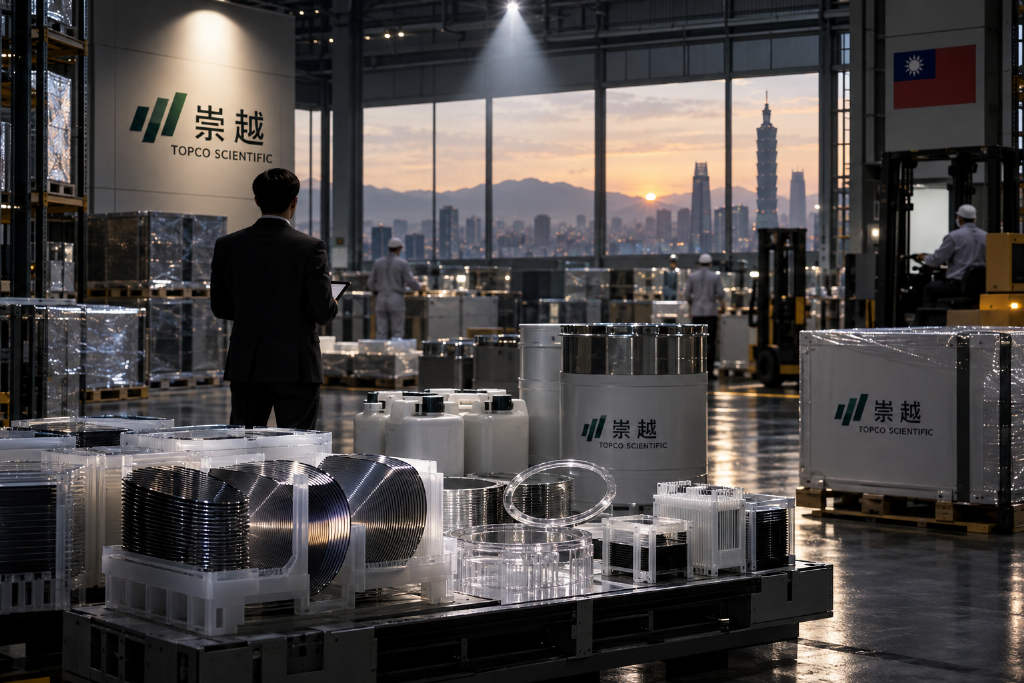
Topco Scientific Co. (5434), a semiconductor materials integrator, reported September 2026 consolidated revenue of about NT$7.7 billion, up 26.4% from a year earlier and the company’s third-highest monthly figure on record. Third-quarter revenue reached NT$23.67 billion, rising 13.6% from the prior quarter and 34.9% year over year, setting a new quarterly high. Revenue for the first nine months totaled NT$63.03 billion, up 25.3% from the same period last year. Chairman Tseng Hai-hua said demand remained strong across advanced process nodes, memory and mature-node production, with capacity running close to full. That lifted sales of key semiconductor materials including photoresist, silicon wafers, quartz products and slurry, all of which posted double-digit growth, according to the report. Topco said semiconductor-related products accounted for 85.8% of first-half revenue of NT$39.36 billion. The company supplies semiconductor materials and integrated services to wafer fabs. Its product lineup includes silicon wafers, photoresist, photomasks, wafer carriers, quartz products and slurry, while it has also expanded into advanced packaging materials. The report added that institutional expectations cited by local media point to a chance of another record in the fourth quarter.
2250
Topco posts record NT$23.67 billion in Q3 revenue as chairman says capacity is nearly full
Nanya Technology
18 days agoNews Editor

Nanya Technology posts TWD 87.63 billion Q3 net profit as AI infrastructure revenue tops 20%

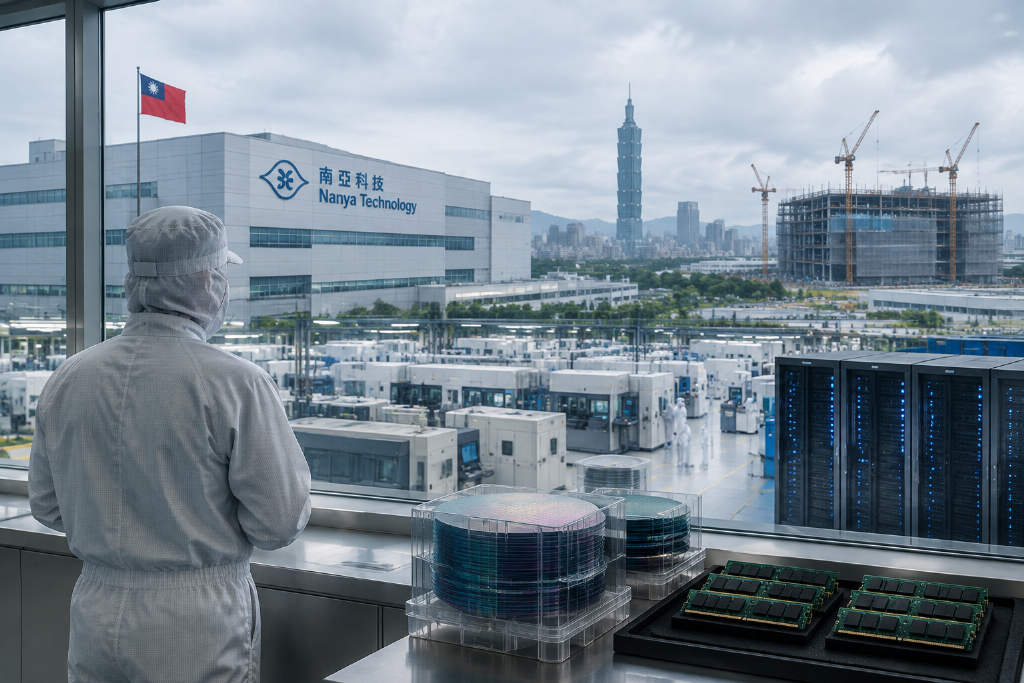
Nanya Technology said at its Oct. 12 investor conference that its self-calculated consolidated results for the third quarter of 2026 set fresh records, helped by tight DDR4 supply and what the company described as a crowding-out effect on capacity among major international memory makers. Third-quarter consolidated revenue reached TWD 133.649 billion, up 61.9% from the prior quarter. Gross margin climbed to 85.7%, operating income was TWD 106.894 billion, and net profit after tax came in at TWD 87.627 billion, with earnings per share of TWD 25.40. The company also said revenue tied to AI infrastructure has officially exceeded 20% of its total. Nanya outlined a large capital spending plan as well, setting a 2026 capex ceiling of TWD 69.7 billion and projecting TWD 346.6 billion in total spending from 2026 to 2029 for the first phase of its new 5A fab. That phase is designed for monthly capacity of 39,000 wafers, with tool move-in scheduled for the first quarter of 2027. The company also said its third-generation 10nm-class 1C process is expected to begin customer validation in the first quarter of 2027, while development of 1D, 1E and EUV lithography remains on schedule. In Pingtung Science Park, it plans to build a 3D wafer packaging and testing facility and introduce TSV and wafer stacking technologies by the end of 2028.

460
Nanya Technology posts TWD 87.63 billion Q3 net profit as AI infrastructure revenue tops 20%
Formosa Plastics Group
1 months agoNews Editor

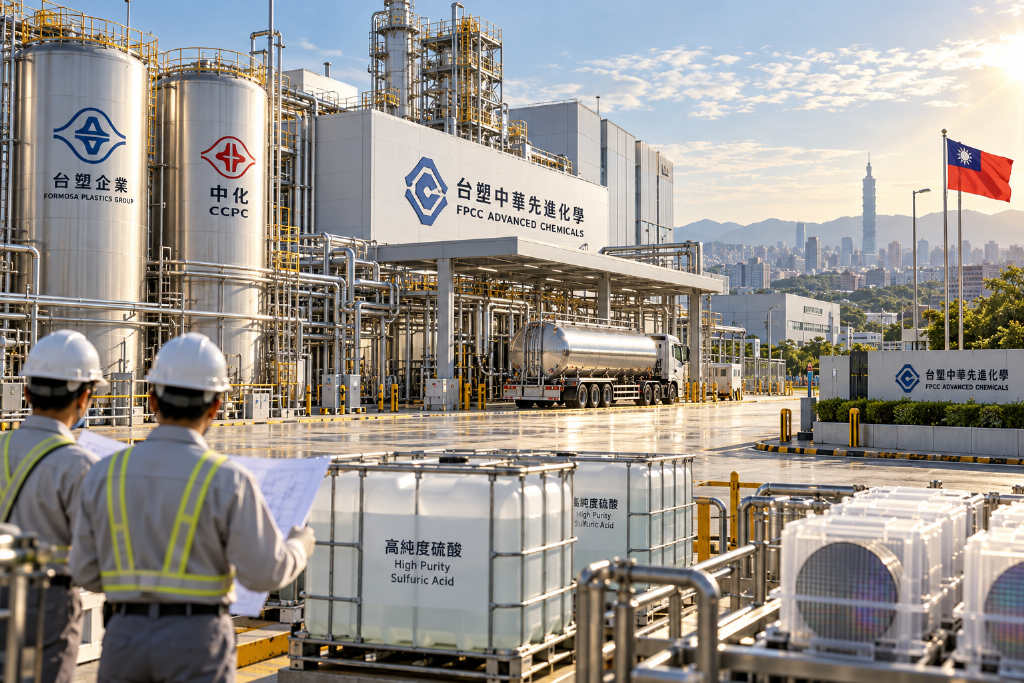
Formosa Plastics Group and Chung Hwa Chemical form JV to target semiconductor-grade sulfuric acid

Formosa Plastics Group has moved deeper into higher-value chemicals by teaming up with Chung Hwa Chemical to establish Formosa Chung Hwa Advanced Chemicals Co. The new venture will have paid-in capital of NT$6 billion, with Chung Hwa Chemical holding 50% and four Formosa affiliates sharing the other 50%. Formosa Plastics will own 20%, while Formosa Petrochemical, Formosa Chemicals & Fibre, and Formosa Biomedical Technology will each take 10% stakes. The first-phase plant is scheduled to begin production in December 2028. According to the source report, the facility will be built in two phases and will mainly produce electronic-grade sulfuric acid used in key semiconductor processes such as wafer cleaning and etching. The report said demand for electronic-grade sulfuric acid in advanced process manufacturing in Taiwan is expected to exceed available supply capacity by 2028 as extreme ultraviolet, or EUV, scaling continues. The venture is aimed at ultra-high-purity semiconductor chemicals including EGSA. The companies said capital will be injected in stages based on actual funding needs of the new entity.

600
Formosa Plastics Group and Chung Hwa Chemical form JV to target semiconductor-grade sulfuric acid
TSMC
1 months agoNews Editor

TSMC Reveals 2nm and 3nm Capacity Expansion Targets for Next Year

TSMC has for the first time disclosed next year’s expansion targets for its 2nm and 3nm production capacity, according to a ChainCatcher report citing supply chain information. Monthly 2nm capacity is set to rise from 90,000 wafers by the end of this year to 110,000 wafers by the middle of next year, a 22% increase. Monthly 3nm capacity is projected to grow from more than 180,000 wafers at the end of this year to 210,000 wafers by mid-next year, up more than 16%. The report also said TSMC’s 3nm monthly capacity reached 120,000 to 130,000 wafers at the end of last year and is expected to expand to 180,000 wafers by the end of this year before moving above 210,000 wafers by mid-next year. For 2nm, monthly capacity is expected to reach 90,000 wafers by the end of this year. TSMC did not comment on market rumors and said any capacity-related information should be based on its official disclosures. The company had previously said its 2026 capital expenditure would be between $60 billion and $64 billion, with about 70% to 80% allocated to advanced process technologies.

1320
TSMC Reveals 2nm and 3nm Capacity Expansion Targets for Next Year
Progate Group
1 months agoNews Editor

Progate Group rallies for a third straight limit-up as advanced-node design push lifts earnings

Progate Group Corp. (8227) has emerged as a key service provider for smaller IC design houses seeking access to Taiwan Semiconductor Manufacturing Co. capacity, as AI-driven demand keeps advanced-node supply tight. While major cloud service providers have turned to large ASIC firms such as Alchip and GUC to secure production slots, Progate is being positioned as a turnkey bridge for companies that lack the scale or budget to work directly with TSMC. According to the source report, Progate has more than 30 years of ties with TSMC and was the first strategic partner in TSMC’s early DCA, or Design Center Alliance. The company now provides end-to-end services covering chip design, wafer tape-out at TSMC, and backend packaging and testing. Recent investor presentation materials show Progate expanding from mature offerings into advanced nodes including 6nm, 5nm, 4nm and 3nm, while also extending into TSMC’s CoWoS packaging and related cooperation with Vanguard International Semiconductor. Financially, the company reported 2025 revenue of NT$1.35 billion, up 97.8% year over year, and second-quarter 2026 revenue of about NT$613 million. Q2 2026 EPS reached NT$2.59, up 304% from the previous quarter and above full-year 2025 EPS of NT$2.06. The stock has now hit limit-up for three straight sessions.

1250
Progate Group rallies for a third straight limit-up as advanced-node design push lifts earnings
TSMC
1 months agoNews Editor

TSMC speeds up 1.4nm expansion at Central Taiwan Science Park, with P1 set for trial run next April

Taiwan Semiconductor Manufacturing Co. (TSMC) is accelerating construction of its second-phase 1.4-nanometer expansion at the Central Taiwan Science Park, according to a Sept. 9 confirmation from the park’s administration. The first plant, P1, has completed its steel structure and is expected to begin trial operations in April next year, with mass production targeted for the second half of the year. That timeline is ahead of the company’s original 2028 production schedule. TSMC has also applied to build two temporary office buildings at the site, both expected to be completed next April. More than 5,400 operations staff and contractors are set to move in during the first wave. The second-phase advanced process project broke ground in October last year and includes four 1.4nm fabs, with nearly 2,000 workers currently on site around the clock. While P1 is moving through floor slab and exterior wall work, P2 has already entered foundation and plant construction and is scheduled for completion in October next year. P3 has obtained its construction permit, and P4 is still awaiting approval. Once all four fabs are completed and fully operational, total staffing is projected to reach 9,000 to 10,000 people.

1260
TSMC speeds up 1.4nm expansion at Central Taiwan Science Park, with P1 set for trial run next April
Samsung
2 months agoNews Editor

Samsung pushes 1.4nm mass production to 2029 as TSMC moves ahead with A16

Samsung has pushed back its 1.4nm mass-production target from 2027 to 2029, extending its focus on the 2nm platform for at least three more years. The shift puts more weight on yield improvement, process maturity and customer adoption, rather than rushing into another node transition. The article argues that Samsung is still developing its 2nm family rather than standing still. In addition to standard SF2, the company is working on derivative 2nm processes for different use cases and plans to introduce backside power delivery in more advanced versions. Samsung has also taken a cautious stance on High-NA EUV, with Vice President Park Chang-min saying the technology still needs to mature and may only become essential for production at A10 and below, or the 1nm class and beyond. That caution stands out as TSMC keeps advancing. According to the article, TSMC’s N2 has already entered mass production, and A16, its first post-2nm node, is scheduled for mass production in the second half of 2026. A16 will use TSMC’s SPR backside power delivery technology. TSMC says that versus N2P, A16 can deliver an 8% to 10% speed gain at the same power, a 15% to 20% power reduction at the same speed, and up to about 10% higher chip density. The piece frames the latest roadmap shift as a sign that leading-edge competition is no longer just a race to the next number. Cost, yield, power delivery, packaging and ecosystem execution are becoming just as important as transistor scaling itself.

1750
Samsung pushes 1.4nm mass production to 2029 as TSMC moves ahead with A16
Total 11 items
Go topage